Token lab: consumption optimization
Two and a half hours, live online, hands-on. You'll price your own prompts against Haiku, Sonnet and Opus with a real API key — provided, credit included — and leave with a rule for which model each job actually needs.
- 17:00–19:30 CEST
- 08:00–10:30 PDT
- 20:30–23:00 IST
- Where the tokens actually live — system prompts, tool definitions, attached files and conversation history, priced line by line.
- Haiku, Sonnet or Opus — what "everyday" and "complex" mean once you measure them, from a testing and a coding angle.
- An API key with credit, provided for the session. Nothing to buy, nothing to install on the day.
One seat · includes materials & follow-up.
Booking 3+ from one team? Get in touch for seats.
What are you actually paying for? Not the words you typed.
In a real working session — a coding agent, a support bot, anything with tools and a history — the sentence you wrote is often well under one percent of what the model reads. The rest is the system prompt riding along on every single turn, the tool definitions, the file you attached six messages ago, and the conversation history compounding underneath all of it. The model has no memory, so every message re-sends the lot — and that packet is the bill.
So the first half is about seeing it. You'll take your own prompts apart and price them live, and leave able to read a prompt's composition before you send it: which slice is big, which slice is stable enough to cache, and which one is quietly doubling every turn. That is the difference between guessing at a cloud bill and predicting it.
The second half is the decision that saves the most money: which model does this job actually need? You'll leave with a working definition of "everyday" and "complex" — not opinions, but thresholds you measured yourself on testing and coding tasks — and a rule for when Haiku is genuinely enough, when Sonnet is the right default, and when Opus earns its five-times price tag. No vendor pitch, no prompt-engineering folklore.
The numbers you'll be reading.


What you'll walk out with.
Every seat includes the live session, a working setup, and everything you need to do this again on Monday.
- 01
A cost model for any prompt — read the bill without a calculator.
- 02
Efficient prompting techniques — which model to choose for which prompt, with worked testing and coding examples.
- 03
What "an everyday task" and "a complex prompt" actually mean, defined by measurement rather than instinct.
- 04
The four levers that actually move the bill, in order of impact.
- 05
An API key with credit for the session — provided, nothing to set up.
- 06
Lifetime access to a framework that measures tokens and cost, and shows the composition of any prompt.
- 07
A one-page cheat sheet and the slides.
What you need on the day.
- VS Code with Python installed — that is the whole setup. Instructions arrive a week ahead.
- No Anthropic account and no card needed — your API key and its credit are handed out at the start of the session.
- Some AI experience, but no deep knowledge. If you've written a few prompts before, you'll be fine.
Save your seat — before someone else does.
You'll get the Stripe receipt and a calendar invite straight away, and the Zoom link the day before.
Secure card payment via Stripe.
The person who'll also answer the email.
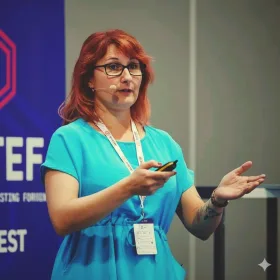
Imola
Software-testing practitioner and quality advocate with fifteen years in the field — across product teams, agencies and in-house QA orgs.
Today Imola runs Pearly Quality from Hungary: the workshops, the monthly letter, and the podcast.