One product, many rulebooks: what accessibility compliance actually asks of you
Two hours, live online, with a short break. An overview of what accessibility compliance actually means — in Europe, in the US, and across the rest of the world — and what a team has to do to meet it. This is not a workshop: we do not walk the success criteria one by one.
- 15:30–17:30 CEST
- 06:30–08:30 PDT
- 19:00–21:00 IST
- What "compliant" actually means — WCAG as a technical standard, and the laws in Europe, the US and beyond that point at it.
- The major regimes side by side — the EAA, Section 508 and the ADA, the UK, Canada, Australia, Japan — who they bind, from when, and to which level.
- What compliance requires of a team in practice: the evidence, the accessibility statement, the timelines — and where the real exposure sits.
An overview of the rules, not a walk through the checklist.
Almost everyone testing a product today is subject to someone's accessibility law — and almost nobody can say which one, at what level, or from what date. The word "compliant" gets used as if it meant one thing everywhere. It does not. WCAG is a technical standard, not a law; what turns it into an obligation is a different statute in every jurisdiction, each with its own scope, its own deadline, and its own idea of who gets to complain.
So this session maps the ground. We go regime by regime, not criterion by criterion: the European Accessibility Act and what changed when it started biting, Section 508 and the ADA and the very different ways they reach a private company, and the rules in the UK, Canada, Australia and Japan. For each one: who it binds, from when, to which conformance level, and what actually happens when someone complains.
Then the part teams get wrong: what compliance asks of you as evidence. An accessibility statement that means something, an audit trail that survives being read by a lawyer, a remediation timeline that is credible rather than aspirational. This is a briefing, not a hands-on workshop — you will leave knowing which rules apply to your product and what "meeting them" concretely looks like, not with a completed audit.
Ten questions, posed from the stage.
These are the questions the session is built around — posed and answered live, with room for your own at the end.
- 01
"We're WCAG 2.2 AA compliant" — what has actually been claimed, and by whom?
- 02
WCAG is a standard, not a law. So what is the law, where you sell?
- 03
The European Accessibility Act — who does it actually bind, and what counts as an exemption?
- 04
Section 508 and the ADA are not the same thing. Which one can reach a private company, and how?
- 05
If you sell in five countries, do you comply with five rulebooks or with the strictest one?
- 06
A, AA, AAA — why does almost every law stop at AA, and what is AAA for?
- 07
What does an accessibility statement have to contain before it stops being a liability?
- 08
What evidence would you actually need if a complaint landed tomorrow?
- 09
Does an automated scan with a green tick prove anything at all in a legal sense?
- 10
What is a credible remediation timeline, and who is allowed to sign it off?
Save your seat — before someone else does.
You'll get the Zoom link the day before the session, and a calendar invite straight away.
The person who'll also answer the email.
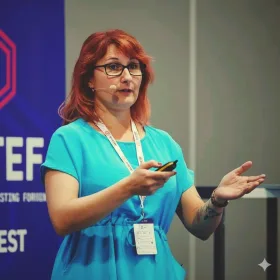
Imola
Software-testing practitioner and quality advocate with fifteen years in the field — across product teams, agencies and in-house QA orgs. Has hired testers, been hired as one, and watched the job market change shape three or four times already.
Today Imola runs Pearly Quality from Hungary: the workshops, the monthly letter, the podcast, and the occasional honest conversation about where this profession is actually going.